Rutherford
Rutherford is one of the last surviving original leaders of the Revolution in George Orwell's Nineteen Eighty-Four, a revolutionary caricaturist who helped inflame the revolt he was later forced to confess to betraying. Arrested with Jones and Aaronson in the great purges of the nineteen-sixties, publicly confessed, pardoned, re-arrested and finally executed, he exists in the book chiefly through Winston Smith's memory — as a ruined colossus in the Chestnut Tree Café, and as the face in a photograph that Winston holds in his fingers for thirty seconds, the only concrete documentary proof of falsification he ever possesses. He is the fate that Emmanuel Goldstein escaped.
Identity and Background
Rutherford belonged to the heroic early days of the Party, when the original leaders of the Revolution were still alive. In the great purges of the nineteen-sixties that leadership was wiped out once and for all: Goldstein fled and went into hiding, a few simply disappeared, and the majority were executed after spectacular public trials at which they made confession of their crimes; by 1970 none of them was left except Big Brother himself. Among the last survivors were Rutherford, Jones and Aaronson — men far older than Winston, "relics of the ancient world", whose names still carried the glamour of the underground struggle and the civil war. Before the Revolution Rutherford had been a famous caricaturist whose brutal cartoons helped inflame popular opinion. By the time Winston saw him that power had curdled into a strange afterlife: his cartoons still appeared in the Times at long intervals, but they were lifeless imitations of his earlier manner, rehashing the old themes of slum tenements, starving children, street battles and capitalists in top hats — even on the barricades, Winston noticed, "the capitalists still seemed to cling to their top hats" — "an endless, hopeless effort to get back into the past." His body told the same story of collapse. He was a monstrous man, with a mane of greasy grey hair and a pouched, seamed face; at one time he must have been immensely strong, but his great body was sagging, sloping, bulging and falling away in every direction, seeming to break up before one's eyes like a mountain crumbling.
The Purge and the Confessions
It must have been in 1965 that the three men were arrested. As often happened, they vanished for a year or more, so that no one knew whether they were alive or dead, and then were suddenly brought forth to incriminate themselves in the usual way. They confessed to intelligence with the enemy — at that date the enemy was Eurasia — to embezzlement of public funds, to the murder of various trusted Party members, to intrigues against the leadership of Big Brother which had supposedly started long before the Revolution happened, and to acts of sabotage causing the death of hundreds of thousands of people. After confessing, they were pardoned, reinstated in the Party and given posts which were sinecures in fact but sounded important, and each of them wrote a long, abject article in the Times analysing the reasons for his defection and promising to make amends. A little later all three were re-arrested, for it appeared that they had engaged in fresh conspiracies from the very moment of their release — a charge that fitted neatly with the whispered legend of the Brotherhood, the vast shadowy army of underground conspirators of which Goldstein was the commander, dedicated to the overthrow of the State. At their second trial they confessed to all their old crimes over again, with a whole string of new ones, and were executed; their fate was recorded in the Party histories, a warning to posterity. The sequence — disappearance, staged confession, ostentatious mercy, re-arrest, re-confession, death — was the Party's purge ritual reduced to its purest form.
The Chestnut Tree Café
Some time after their release Winston had actually seen all three men, in the Chestnut Tree Café — the ill-omened haunt where the old, discredited leaders of the Party had been used to gather before they were finally purged, and where Goldstein himself, it was said, had sometimes been seen years and decades ago. It was the lonely hour of fifteen; the café was almost empty; a tinny music trickled from the telescreens, and the three men sat in their corner almost motionless, never speaking, with a chessboard set out beside them but no game started. Winston watched them at a safe distance, feeling a terrified fascination. They were outlaws, enemies, untouchables, doomed with absolute certainty to extinction — "corpses waiting to be sent back to the grave", since no one who had once fallen into the hands of the Thought Police ever escaped in the end. He studied Rutherford's ruinous face and, for the first time, noticed that both Aaronson and Rutherford had broken noses. Then, for perhaps half a minute, something happened to the music from the telescreens: it changed into "a peculiar, cracked, braying, jeering note" — a note Winston privately called "a yellow note" — and a voice sang "Under the spreading chestnut tree", with its refrain of mutual betrayal, "I sold you and you sold me". The three men never stirred; but when Winston glanced again at Rutherford, his eyes were full of tears.
The Photograph and the Erased Past
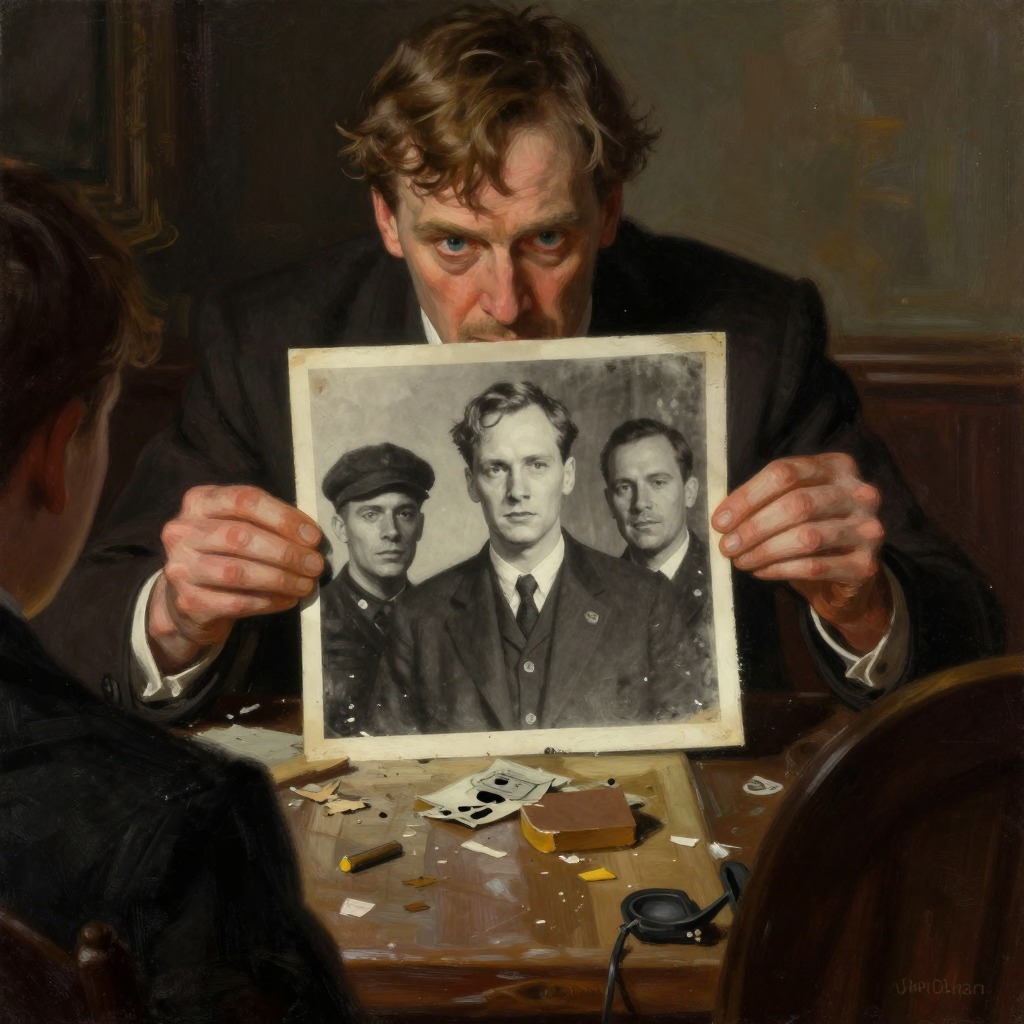
The one hard fact in Rutherford's story surfaced by accident. About five years after the executions, in 1973, Winston was unrolling a wad of documents in the Records Department when he came on a fragment of paper which had evidently been slipped in among the others and then forgotten: a half-page torn out of the Times of about ten years earlier, the top half of the page, so that it included the date, containing a photograph of the delegates at some Party function in New York, with Jones, Aaronson and Rutherford prominent in the middle and their names in the caption. The date chanced to be midsummer day — the very date on which, at both trials, the three men had confessed to being on Eurasian soil, flown from a secret airfield in Canada to a rendezvous somewhere in Siberia, where they had conferred with members of the Eurasian General Staff and betrayed important military secrets. There was only one possible conclusion: the confessions were lies. This was not in itself a discovery, since Winston had never imagined that the purge victims had committed the crimes they were accused of; but it was the only concrete, unmistakable documentary proof of a falsification he would ever possess. The fragment stayed between his fingers for as long as thirty seconds, and it struck him as being like "a fossil bone which turns up in the wrong stratum and destroys a geological theory" — enough, if it could somehow have been published to the world, to "blow the Party to atoms". Instead, by luck, it had unrolled upside-down from the point of view of the telescreen; he covered it up with another sheet of paper, let what he judged to be ten minutes go by, fearing that a sudden draught would betray him, and then dropped it into the memory hole with the other waste paper to be whirled away to the furnaces. Even its meaning was already unstable: by then Oceania was no longer at war with Eurasia, so the dead men must have betrayed their country to the agents of Eastasia instead; and the confessions had been re-written and re-written until the original facts and dates no longer had the smallest significance. The past, Winston reflected, not only changed, but changed continuously. Writing the diary years afterwards, he thought that today he would probably have kept the photograph.
O'Brien's Account of the Ending
The public ending of Rutherford's story was the second execution. The private ending is supplied by O'Brien during Winston's re-education in the Ministry of Love. In an earlier session, questioning Winston about the photograph, O'Brien dismisses it as a hallucination: the three men, he says, were "executed for treachery and sabotage after making the fullest possible confession". He lets Winston glimpse another copy of the picture, then drops it into the memory hole, saying that it does not exist and that it never existed. Winston cries, "But it did exist! It does exist! It exists in memory. I remember it. You remember it." O'Brien answers, "I do not remember it" — a denial which is itself an act of doublethink. Later, describing the end of the trio, O'Brien claims that he took part in their interrogation himself. They were gradually worn down, he says, whimpering, grovelling, weeping, until "in the end it was not with pain or fear, only with penitence." By the time the Party had finished with them they were only "shells of men", with nothing left in them except sorrow for what they had done and "love of Big Brother". They begged to be shot quickly, he says, so that they could die while their minds were still clean. Watching O'Brien as he speaks, Winston is convinced that he is not pretending and that he believes every word he says.
Thematic Significance
Rutherford's fate is the novel's clearest demonstration that the Party manufactures its own enemies and then erases the manufacture. The regime that had once relied on his cartoons to inflame the Revolution rewrote him as a traitor, forced him to confess to crimes against a leadership he had helped create, forgave him, destroyed him, and then revised the record until he could never have been anything but an enemy. Nothing survives of him except counter-evidence locked in a single man's memory — and the novel keeps testing how much that is worth. Watching his fellow Party members swallow the announcement that the battle for production had been won and the standard of living had risen by no less than twenty per cent, that demonstrations were thanking Big Brother for raising the chocolate ration to twenty grammes a week when only the day before it had been announced that the ration would be reduced to twenty grammes, Winston wonders whether he is alone in the possession of a memory. Rutherford is the historical version of that question: his truth survived only in Winston's fingers, for thirty seconds. The trio's story also shadows the Two Minutes Hate, in which Goldstein, the escaped leader, is ritually execrated as "the primal traitor": Rutherford, Jones and Aaronson are the leaders who did not escape, and so their names could simply be excised from history. In the Cold War context in which the novel was first received, their conversion and death also read as the Party's brainwashing made visible — the conditioning of heretics into useful political reflexes, the application to politics of Pavlov's laboratory dogs. What makes their destruction final is not the execution itself but the doublethink that lets the Party deny the evidence of its own past.